Milestone 1
Secure Attachment
Birth through age 2
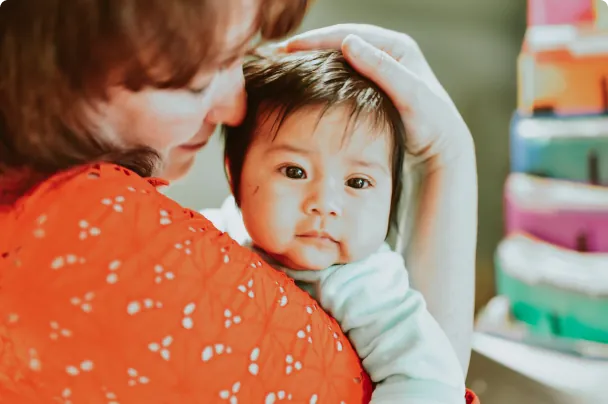
Secure attachment is the strong, trusting bond that forms when a child has consistent, nurturing care from a primary caregiver (including parents, grandparents or other kin caregivers, foster parents, or guardians). When children are in child care or preschool, secure attachment can also be supported by stable, responsive relationships with early educators.
The earliest months and years of a child’s life are the most formative time to build healthy relationships. This relational health shapes how children grow, learn, and relate to others for the rest of their lives.
Why it’s important
Children develop secure attachment when their adults have the support they need to respond consistently and appropriately to their cries, babbles, and bids for connection. These interactions:
- Help children feel safe and regulate their emotions.
- Support healthy brain development and early learning.
- Foster strong relationships with others.
- Safeguard children from the harmful effects of stress.
- Allow children to explore their world with confidence and curiosity.
How Oregon measures up

When caregivers have the support they need, they’re better able to respond to a baby’s cues with warmth and consistency, building secure attachment. Oregon’s home visiting system is one key support, but reach is limited and hard to measure across multiple programs.

A caregiver’s well-being shapes a baby’s sense of safety. Paid leave, stable housing and food supports, and timely access to physical and behavioral health care allow caregivers to respond consistently to a child’s needs, which helps foster secure attachment.

When families have access to early, relationship-based support, they can build secure attachment and stability during a child’s earliest months.
Source: National Home Visiting Resource Center
Note: National comparisons draw on estimates from the National Home Visiting Resource Center. NHVRC does not publish state rankings due to differences in eligibility definitions and program models.

Early ACEs, including abuse, neglect, and household instability, disrupt brain development and increase lifelong risk of depression, addiction, and chronic disease.
Indicator 1
Screening and treatment for postpartum depression and maternal mental health
Depression or anxiety during pregnancy and after birth without adequate treatment can interfere with the emotional availability and steady presence that help secure attachment take root.
Oregon does not currently track whether parents who screen positive for postpartum depression receive timely follow-up care. Without that data, Oregon cannot know whether its investments in screenings result in the care families actually need.


Oregon recommendations
Leverage Oregon’s routine prenatal, postpartum, and infant well-child visits to identify depression, anxiety, and parenting stress and connect families to support early.
Caregivers should promptly receive a warm handoff, a scheduled appointment, or a trusted community referral.
Increase timely, affordable access to perinatal and parent mental health and substance use disorder treatment through Oregon Health Plan–covered services and integrated models, including Project Nurture and other community-rooted approaches.
Ensure services align with what families want, trust, and will use, by expanding capacity for dyadic parent-child therapy, infant and early childhood mental health consultation, and community-rooted supports.
Indicator 2
Home visiting reach and doula supports
Home visiting programs and community doulas give families steady, relationship‑based support during pregnancy and in the earliest months of a child’s life, when stress is highest and secure attachment is taking shape.
It’s hard to measure “unmet need” precisely because home visiting data is spread across multiple programs, eligibility rules differ, and enrollment counts can’t always be combined into a single unduplicated total.



Data from 2024 – Source: NHVRC

Although Oregon’s Traditional Health Worker certification dashboard tracks how many doulas are certified in the state, Oregon does not have more recent data on use of doula support for births covered by Medicaid.
Oregon recommendations
Ensure families receive relationship‑based help early in pregnancy and throughout a child’s first three years, before stress escalates into crisis.
Expand and maintain the Community-Based Perinatal Services Access Fund and related state investments to support recruitment, training, supervision, and retention of community-based doulas, including culturally specific and rural workforce pathways.
Prioritize growth to serve rural and remote communities, communities of color, low-income families, and families experiencing housing instability, and build stronger referral pathways through Oregon Health Plan coordinated care organizations, prenatal care providers, and pediatric clinics.
Indicator 3
Prevention of Adverse Childhood Experiences (ACEs) and promotion of Positive Childhood Experiences (PCEs)
Adverse Childhood Experiences (ACEs) like violence, abuse or neglect, and witnessing violence, as well as broader conditions such as food insecurity, homelessness, and unstable housing can have profound and lasting effects on a child’s sense of safety and stability, both at home and in the community. At the same time, Positive Childhood Experiences (PCEs), especially safe, stable, nurturing relationships and environments and caring adults within and outside a child’s family, can buffer stress and help children thrive. PCEs can even ameliorate the effects of ACEs.
Early childhood exposure to ACEs correlates with poorer physical, mental, behavioral, and emotional health, as well as poorer educational and social outcomes throughout a person’s life. Conversely, exposure to PCEs in early childhood can be protective and ameliorative, setting a child up for better life outcomes even if they have some ACEs exposure.


Oregon recommendations
Increase access to IECMH consultation in child care, preschool, home visiting, and pediatric settings, so adults supporting young children receive real‑time coaching to strengthen relationships, prevent escalation, and reduce suspensions and expulsions.
Expand and strengthen referral pathways into Relief Nurseries and other early childhood family support hubs — programs designed to prevent child abuse/neglect through integrated supports like home visiting, parenting education, outreach/crisis support, and supported referrals for families with multiple stressors.
Increase availability of infant and early childhood mental health services grounded in child development and relationships, supported through appropriate workforce training.
Prioritize streamlined enrollment and renewal for OHP, SNAP, TANF, and ERDC, and ensure families can get live phone or in‑person assistance for applications or paperwork.
Standardize referrals and closed‑loop follow‑up across health care, community-based organizations, and child welfare using Oregon’s Community Information Exchange infrastructure.
Shared referral pathways with follow‑up, such as Help Me Grow, reduce drop‑off and ensure prevention and support services reach families early, when they are most effective.
Acting on the data
Inadequate systems of support for new parents and caregivers create disparities in early relationships and well-being that widen along lines of race, ethnicity, income, disability, language, and geography, and last beyond childhood.
Oregon can strengthen attachment and target disparities by aligning and investing in key strategies, including:
- Increasing access to home visiting services and traditional health workers (e.g., birth doulas, community health workers, and peer support specialists) to support families during pregnancy and early childhood.
- Expanding parenting education and coaching (i.e. Oregon Parenting Education Collaborative).
- Supporting household income security (i.e. Oregon Kids Credit, EITC, Paid Leave Oregon).
- Delivering comprehensive mental health screening, family friendly navigation support, and early childhood behavioral health services (i.e. parent-child therapy).